

Centered on the concept of the “Intelligent Factory,” this framework integrates four collaborative subsystems to organically unify the physical layer, control layer, analytics layer, and decision-making layer: :
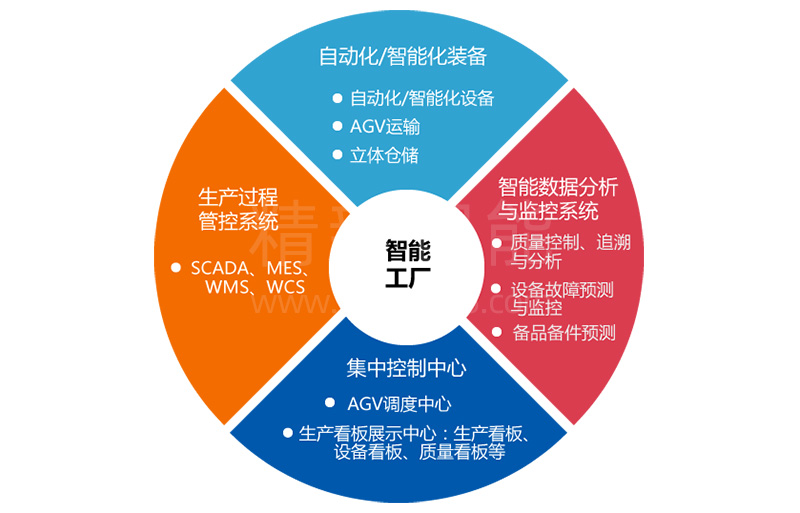
1. Automated/Intelligent Equipment
Includes automated production line equipment, AGV-based intelligent transport systems, and automated storage facilities, forming the execution endpoints of the factory to support automated material flow and process operations.
2. Production Process Control System
Integrates systems such as SCADA, MES, WMS, and WCS to enable end-to-end closed-loop management—from order placement and process scheduling to quality control and warehouse execution—ensuring smooth and orderly production operations.
3. Intelligent Data Analytics and Monitoring System
Focuses on quality control, process traceability, predictive equipment failure analysis, and forecasting spare parts demand. Leveraging real-time data streams, it performs dynamic analytics to support maintenance, operational decisions, and continuous improvement.
4. Centralized Control Center
Serving as the unified command hub, it includes an AGV dispatch center and a production dashboard center (featuring multi-dimensional visualizations of production, equipment, quality, etc.), enabling holistic situational awareness and rapid response capabilities.
This framework emphasizes modular design, open interfaces, and phased implementation. Each subsystem can be deployed independently or integrated collaboratively, accommodating the diverse scales and maturity levels of manufacturing enterprises pursuing digital transformation.
Zhejiang Jingxin Intelligent Technology Co., Ltd. offers end-to-end technical services based on this architecture—including planning consultation, system integration, implementation, and operations support—to help clients build intelligent factories that are stable, transparent, and capable of sustainable evolution.
Note: All systems listed in the diagram represent standard industry functional modules. Specific configurations are customized according to the client’s production line characteristics.